
By Sam DeLong
Editor’s note: In honor of Earth Day, CN&R presents a local story about an environmentally-friendly option to solving a widespread problem.
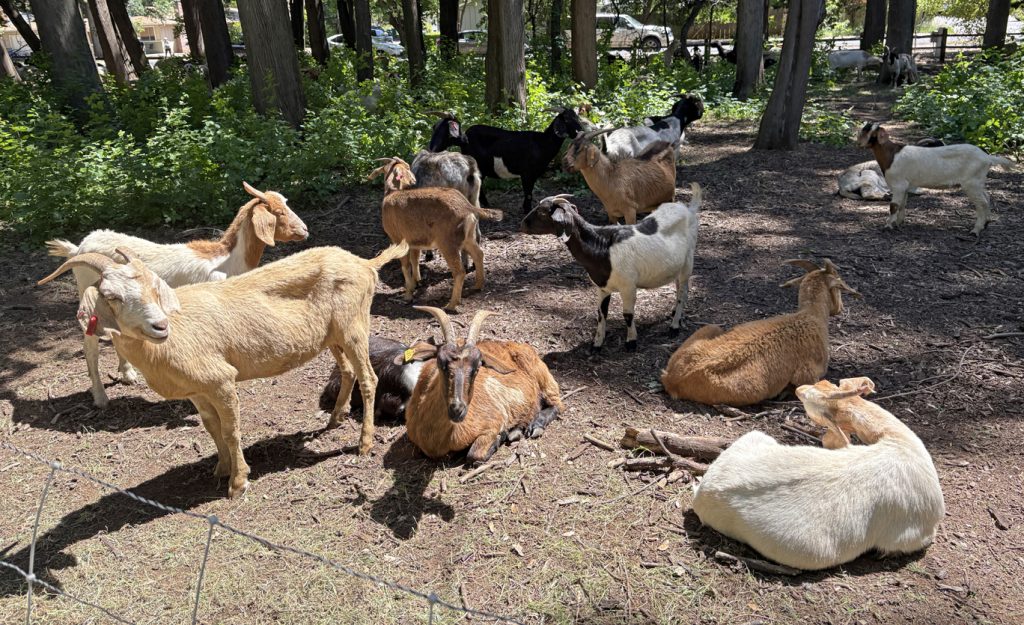
In a world stocked with industrial-strength herbicides, we can rely on one of agriculture’s oldest tools to change the landscape. In a joint effort between the Paradise Grazing Company (PGC) and the City of Chico, herds of goats are being deployed to clear overgrowth.
This current project is aimed at eliminating poison oak ahead of the 2026 Endangered Species Faire to be held in Lower Bidwell Park on May 2. Using goats for vegetation control has been an annual practice in the area since around 2002. City of Chico Parks & Natural Resource Assistant Manager Lindsay Amundson says the long-running ecological program is rooted in safety.
“We have been using the goats for over 15 years. This method is not only more effective at removing overgrowth, but it’s also quicker and protects kids from exposure to harsh chemicals.” Amundson says the program is done yearly and is especially important in the case of poison oak due to more children being outdoors during summer break.
Clayton Hodges founded PGC, the “goat-scaping” operation, in 2020. Drawing from his background as a firefighter, he developed a way to use livestock as a natural form of fire prevention.

“There are a couple of ways to do this—by hand, with machines, or with goats,” Hodges said. “The goats are much better on steep hills and rough terrain, and they can navigate obstacles that machines simply can’t.”
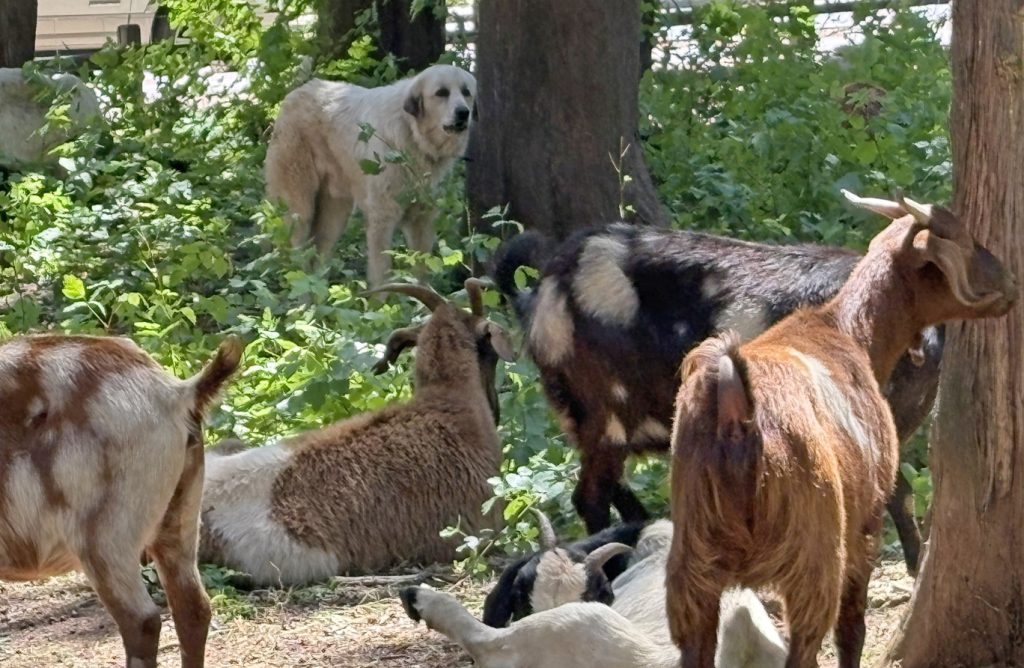
The Bidwell Park project however, is relatively flat and easier to navigate. The vegetation-clearing efforts, handled by the PGC, are concentrated in the Cedar Grove area, near where the Endangered Species Faire will take place. There is a guard dog and also a PGC employee on site at all times.
For this contract, Hodges and his team are herding Kiko and Boer goats, though Spanish goats are also sometimes used. Spanish goats—often referred to as brush goats—are a breed particularly well suited for the job because of their ability to consume a wide variety of plant material. Notably, Spanish goats are immune to urushiol, the toxic oil that causes skin irritation in humans.
Hodges said grazing goats are also frequently used to clear dams, which are often too steep and rocky for safe human access. He estimates it takes roughly 360 goats to clear an acre per day, though it depends on the animals’ temperament.
“They will eat it, but sometimes they go slower on some days than others. They also don’t really like the taste of poison oak over long periods, so we mix in some alfalfa to keep ’em going.”
While the City of Chico contract is primarily focused on the Cedar Grove area, Hodges says he regularly takes on additional jobs throughout Chico and nearby areas such as Forest Ranch. He also provides services to private landowners.
2026 is the first year the City of Chico has made a contract with the PGC. While similar overgrowth is often seen in the Lindo Channel area, Hodges notes those efforts are likely being handled by a different grazing company, while his operation focuses on Lower Bidwell Park.
“We don’t do much during the fall, since not much is growing,” Hodges said. “But in the spring and summer, there’s plenty of work. The goats’ clear vineyards and other overgrown properties.”
Following the contract, the herd will leave Chico and move on to projects in other areas. Hodges also confirmed the animals spend their winter downtime grazing at a facility in the town of Marina, near Monterey.
For larger jobs, Hodges transports the goats using a trailer capable of carrying up to 200 animals at a time. A 12-volt electric fence is set up to contain the herd, and guard dogs are used to protect them from predators.
“Sometimes goats get out,” Hodges said. “They’ve broken fences and wandered into private yards. One time, my trailer broke down in the middle of nowhere and I had to camp overnight at a park. Some police officers and nearby residents brought water, and I set up a temporary fence on the spot.”
The goat-scaping program offers a safe, efficient alternative to chemical treatments and heavy machinery, while giving the goats a satisfying meal as they help reduce fire risk, noxious weeds and protect the environment.
In the mid 90’s me and students at CSUC pressured the city parks dept. to stop using herbicides and utilize IPM [Integrated Pest Management] practices and goats, as the Campus Arboretum Club worked with Facilities and Grounds Management with similar policies. I am still on the Campus Arboretum Committee.