
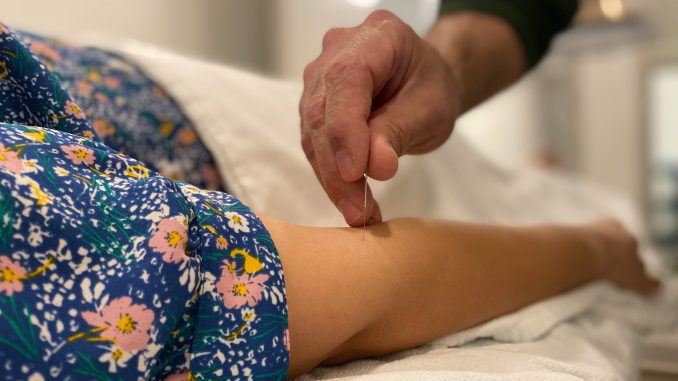
By Dr. Stephanie Cheng

America’s opioid crisis touches nearly every family. Roughly 5.7 million Americans live with opioid use disorder, and about one in three adults say they or someone in their family has battled addiction.
As an anesthesiologist, I see one of the main entry points into opioid use every day: surgery. Powerful painkillers are routinely prescribed to manage surgical pain, even though they carry a high risk of dependency.
For years, many physicians have been searching for ways to reduce reliance on these drugs. My own work has focused on an approach that does exactly that — intraoperative acupuncture.
Unfortunately, patients who want this option are often prevented from receiving it — not because the science is lacking, but because outdated regulations stand in the way.
Surgical procedures place enormous stress on the body, and managing pain effectively during and after an operation is critical. The technique I developed, known as the CHENG Protocol, is performed once the patient is already under anesthesia. Small needles are placed at specific points on the ear associated with pain, inflammation, anxiety, fear, and memory. In some cases, the treatment also involves gentle electrical stimulation. The process does not disrupt the surgery in any way.
The results, however, can be significant. Intraoperative acupuncture has been shown to lessen post-surgical pain and reduce the amount of opioids patients need during recovery.
In one of my studies involving knee replacement patients, 65% of those who received acupuncture were able to stay on a low-dose opioid regimen during the first month after surgery. Among patients who did not receive acupuncture, only 9% achieved the same outcome.
Despite these benefits, many anesthesiologists are unable to offer this treatment. The primary barrier is regulation. Acupuncture training rules differ widely from state to state. In New York, South Carolina, Georgia, and Louisiana, physicians are required to complete as many as 300 hours of acupuncture coursework.
Some states further limit which programs qualify, making it difficult for working physicians to meet the requirements. New York, for instance, mandates that at least 200 hours be completed through state-approved programs that are often inaccessible or impractical.
Elsewhere, the rules are vague or inconsistent. States like Montana and New Mexico lack clear guidance, while Hawaii prohibits physicians from practicing acupuncture altogether. These restrictions make it extremely difficult for anesthesiologists to incorporate a targeted, evidence-based therapy into surgical care.
There is reason for optimism. Legislators have begun introducing bills to modernize these laws. In New York, one proposal would amend education statutes to allow clinicians without full acupuncture credentials to perform auriculotherapy — or ear acupuncture — under narrowly defined conditions.
Such a change would allow anesthesiologists to complete focused training specific to intraoperative acupuncture, rather than enrolling in a months-long general program. Patients could begin benefiting from this approach much sooner.
Other states should consider similar reforms. Intraoperative acupuncture is not a fringe treatment or an untested idea. It is a precise, research-backed tool that can reduce opioid exposure and improve surgical outcomes.
Patients are asking for better options. Physicians are ready to provide them. State laws should not stand in the way.
Stephanie Cheng, MD, is a board-certified anesthesiologist and medical acupuncturist at Hospital for Special Surgery and creator of the CHENG Protocol.
I am very sorry to see this. Acupuncture was debunked in 2005. This was after a very long time of being an unanswered question that was being scientifically tested. Multiple high-quality clinical trials and meta-analyses starting in the mid-2000s showed that acupuncture performs no better than sham acupuncture, meaning its traditional explanations—meridians, “chi,” point specificity—have no scientific validity. Whatever benefit exists is a placebo or context effect.
So perhaps these reported results from use with anesthesiology is a contextual thing. But I would have to see some very good reasons for using it.