
We look at the importance of California’s November 4 ballot measure
By Ken Magri
In the upcoming November 4 special election there is one issue to vote on, just one.
Proposition 50 is asking whether voters want to “authorize temporary changes to our state’s congressional district maps in response to Texas’ partisan redistricting.” If passed, the measure could make it almost impossible for longtime Butte County congressman Doug LaMalfa to get re-elected in the future.
This proposition, put on the ballot by Governor Gavin Newsom and the legislature’s Democrat majority, is designed to nullify what critics see as unethical tactics by Texas legislators and the Republican party to unfairly flip five congressional districts in the Lone Star state from Democrat into Republican seats.
But due to Proposition 50’s unusual purpose, there remains some misunderstanding about what Californians are voting on.
A more comprehensive ballot wording might have asked if voters want to “suspend California’s independent redistricting process for the 2026, 2028 and 2030 elections only, using new maps designed to deny five Republican seats in California, as a counterbalance to recent actions by the Texas legislature of adding five new Republican seats through a redistricting process seen as unfair but having national consequences and demanded by the president.”
Even that long-winded version needs explaining. News & Review decided to dive in and answer frequently asked questions about why voters should care about Proposition 50 in November.
What does “Yes” or “No” mean?
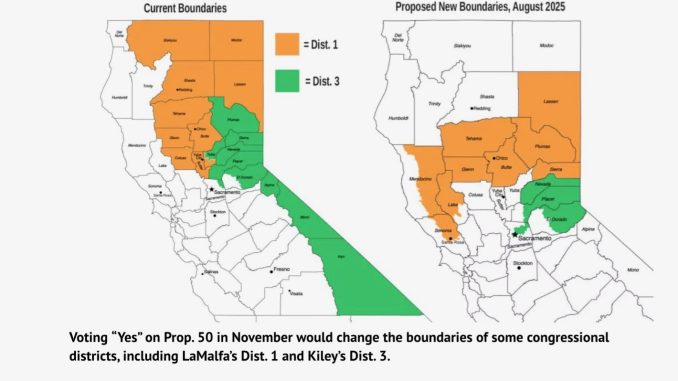
A “yes” vote says that the voter wants to use California’s newly drawn redistricting maps for the next three California state elections, through 2030. These new districts, including a reconfiguration of California’s First District, will affect North Valley voters by favoring Democrat candidates.
From 2031 onward, all subsequent elections will go back to the independent panel redistricting process as originally designed.
A “yes” vote also says that the voter supports creation of a national election redistricting system, made up of independent nonpartisan members, although this part of proposition is for advocacy only.
A “no” vote says that the voter wants to stay with the current California congressional maps, making no changes until the next redistricting effort begins after the 2030 census.
A “no” vote also means the voter does not wish to respond to the Texas legislature’s redistricting actions.
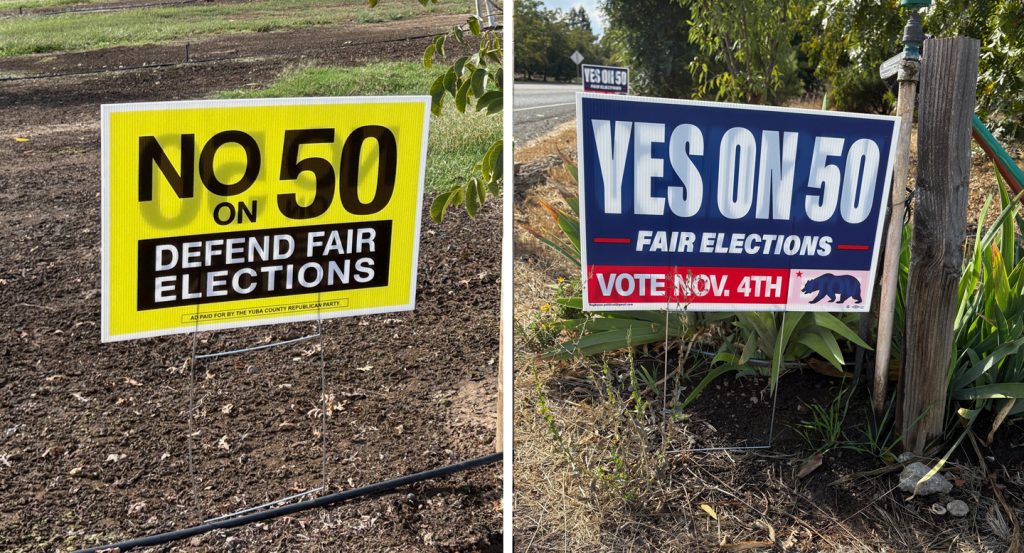
Both sides claim they are saving democracy.
Democrats say their proposition only corrects the anti-democratic nature of what Texas did. Republicans mostly ignore the Texas issue but still say that two wrong gerrymandering actions will not make things right.
Why have a costly special election this year instead of 2026?
Because it would be too late by 2026.
The Texas legislature already redrew its election maps this summer, in time for the 2026 primary and general elections. At President Trump’s request, this was implemented five years before the traditional 10-year timeline that all other states adhere to.
Texas changed its electoral make-up by slicing up Democrat voting concentrations to significantly increase the advantage for Republican candidates. Having five fewer Democrats and five more Republicans would allow the Republican Party to retain its majority in the US. House of Representatives.
Many Americans consider the Texas redistricting to be “gerrymandering,” an unfair and discriminatory practice that disenfranchises huge blocks of voters. For Californians to nullify these Texas changes, the proposition would need to be passed in time for the 2026 elections.
If Texas redistricting is gerrymandering, isn’t Proposition 50 the same thing?
Yes, it has similarities, but no, it is not the same thing.
Like Texas, California’s new congressional districts under Proposition 50 were designed by politicians to disproportionately favor the majority party.
But California’s maps must be approved by voters through Proposition 50. The Texas legislature shut voters out of their process.
In addition, Proposition 50 only lasts through the 2030 election, when independent redistricting returns to California. In Texas, the legislature will still control its own congressional redistricting.
Finally, Proposition 50 supports the implementation of a nationwide redistricting system after the 2030 census. Texas does not.
Who funds the Yes and No campaigns?
As of September 26, over $100 million has been raised for this ballot measure, according to official campaign filings. Millions of dollars are already being spent on both sides. Tens of millions more are waiting to be unleashed.
With more than 65,000 individual donors, most of whom donated an average of $150, the “Yes on 50” campaign controls a war chest three times the size of the opposition. It also accepted large donations from the California Teachers Association, the California Nurses Association, the Democratic Party, Governor Newsom and a political action committee partly funded by George Soros.
The “No on 50” campaign reported about 130 donors including various Republican political action committees. Its largest single donor is Charlie Munger Jr., a Palo Alto philanthropist who gave $30 million and was involved in the original 2008 effort to create California’s independent redistricting.
Munger is against gerrymandering and wants independent redistricting for the entire nation. Nevertheless, he has not taken a position on the Texas legislature’s actions that inspired the proposition he is now opposing. He gave tens of millions to Republican candidates over the years, although his support dwindled in 2017.
Proposition 50 supporters are targeting Munger in ads, describing him as an anti-abortion “mega-millionaire” enabling Trump’s wishes. Considering that Trump’s disapproval rating in California is 68%, linking the No campaign to the president could be effective.
In campaign ads against the “Yes” forces, Gavin Newsom is the main target, being accused of launching a “power grab” for his future political aspirations.
Who is endorsing Proposition 50 and who is endorsing its defeat?
In addition to Gavin Newsom, Proposition 50’s most prominent individual endorser is President Barak Obama. While initially cautious, Obama said after the Texas actions, “if we don’t respond effectively, then this White House and Republican-controlled state governments all across the country, they will not stop, because they do not appear to believe in this idea of an inclusive, expansive democracy.”
The “No on 50” campaign has the support of Governor Schwarzenegger. He championed the independent redistricting process back in 2008 and 2010. Speaking at the University of Southern California, he said, “It doesn’t make any sense to me that because we have to fight Trump, we have to become Trump,” Schwarzenegger said. “Two wrongs don’t make a right.”
Early in the campaign, the No forces sent out mailers wrongly claiming support from the League of Women Voters. The league immediately issued a press release expressing neutrality, and the Yes forces took out ads accusing the No forces of misleading Californians.
What do the polls say?
The most recent Emerson College poll from September has Proposition 50 winning by 51% to 35%. But a 15% block of undecided voters has pollsters cautioning that turnout is important and opinions could change as the campaign continues.
Whichever way this election goes, Proposition 50 could become as famous as California’s influential Proposition 13 in 1978, which limited property tax hikes, and Proposition 64 in 2016, which legalized recreational cannabis.
A victory could help ignite a 2028 presidential run from Newsom. But if the proposition goes down to defeat, it could have the governor looking like an electoral loser to the rest of the nation.
Either way, the stakes are high for an off-year California election which traditionally averages a 33% turnout. That makes every individual’s vote more important this time around.
Be the first to comment