
By Sarah Russell
In December 2020, wildlife photographer Randy Robbins was walking in the woods by his Susanville, Calif., home when he came across a dead doe covered with a layer of frost. He used his cell phone to take a picture of her (she was too close for the 400-millimeter lens he was carrying), and he posted it to social media.
Robbins titled the photo “Full Circle,” and in 2024, it became the first photo taken with a smartphone camera to win an award in the 60-year history of the Wildlife Photographer of the Year competition, put on by the Natural History Museum in London.
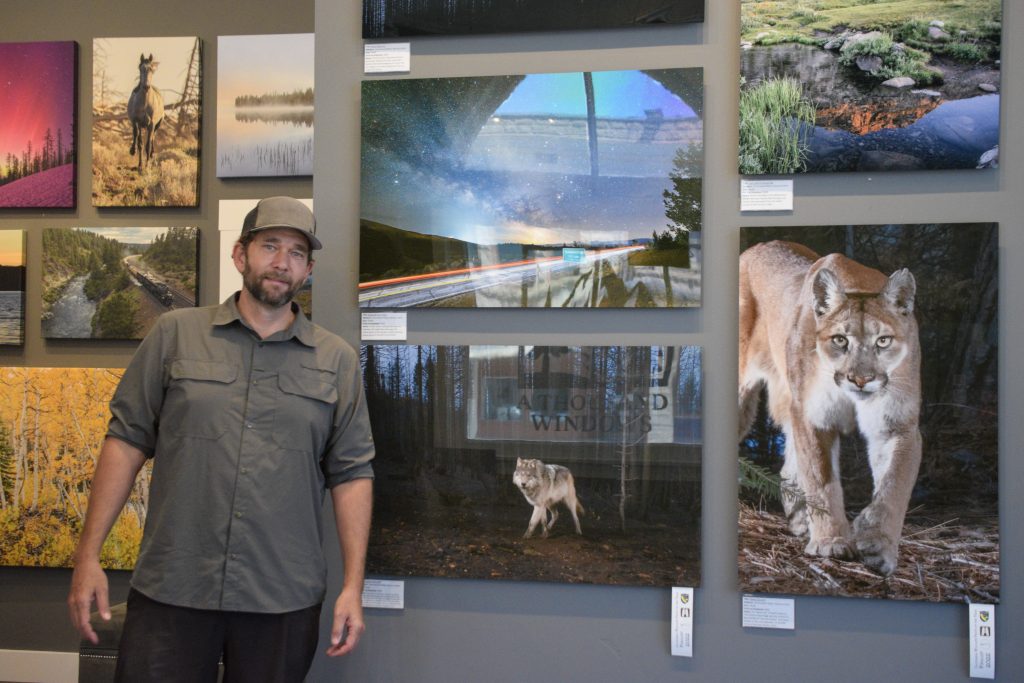
On a recent weekend afternoon, Robbins met with the N&R in his wife’s law office—which adjoins his downtown Susanville gallery, A Thousand Windows—surrounded by beautiful prints of the doe, a gray wolf, bobcats, mountain lions, bald eagles and landscapes. The photographer, part-time pastor and former teacher shared the story of how the doe photo kicked off a series of events that led to him getting what scientists say is the first-ever professional, high-resolution photograph of a Sierra Nevada red fox.
‘How hard could that be?’
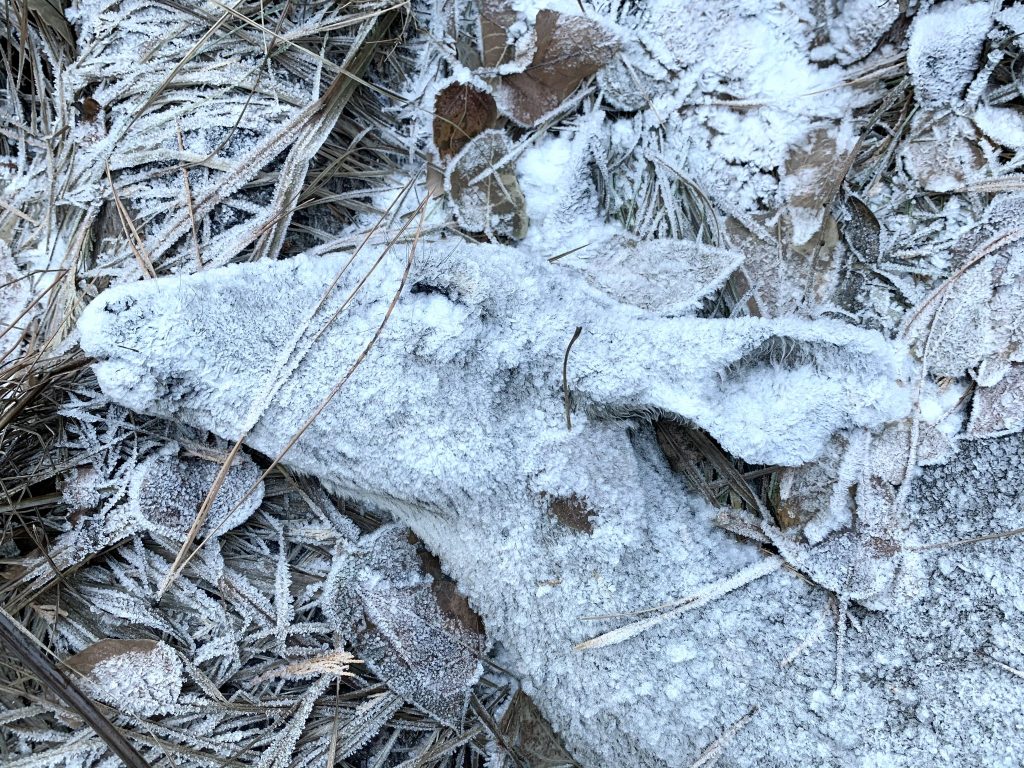
Robbins realized that bobcats and other wildlife would be coming by to feed on the doe’s carcass. He set up trail cams, which take video when they detect movement, to see what kind of animals would come by, and when. He then built a camera blind (like a hunting blind), so animals wouldn’t see him when he was shooting in-person.
The trail cams showed that a bobcat kept coming to feed on the doe—in the middle of the night, not during the long hours Robbins spent waiting in the blind. The frustration of not getting the shot inspired him to learn more about camera traps, which are much more than trail cams: They use a digital single-lens reflex (DSLR) camera and yield higher-quality photos.
After some experimentation, Robbins developed a system using trail cams to show animals moving in the area, with the shutter of the camera trap—a DSLR camera in a weatherproof housing—set off by a motion trigger.
There was a lot of trial and error. The timing between trigger and shutter has to be precise, and the focus has to be set manually.
“It can’t autofocus at night,” Robbins said. “So you have to know within inches where you’re hoping the animal is going to walk by.”
His setup requires 40 AA batteries every three weeks, so the traps, typically in remote areas, must be checked and refreshed regularly.
Throughout 2021, Robbins said, he captured hundreds of images—of squirrels, mountain lions, bobcats and gray foxes. He practiced his lighting and timing techniques on them, learning which shots work in daylight and at night.
Robbins, who had been teaching at Lassen High School when a gray wolf called OR-7 became the first spotted in California since the 1920s, was fascinated by the wolf and his travels. He and his students followed online posts about the wolf’s movements. Eventually, OR-7’s offspring led to the establishment of the Lassen pack of gray wolves in 2017.
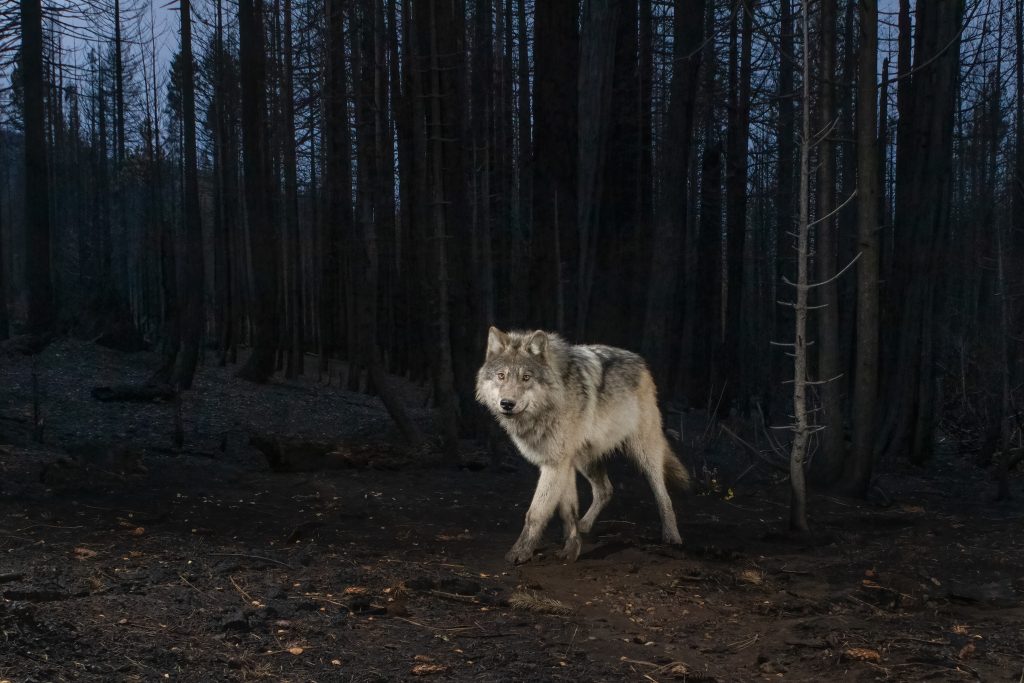
Once Robbins mastered photo-trapping, he realized he could probably get the first-ever high-resolution shot of a California gray wolf. He studied reports from ranchers and biologists indicating where the wolves might be, and set up a camera trap in the forest.
In July 2021, the Dixie Fire broke out, forcing Robbins to take his gear down. After the fire, he went back to see if he could find signs of the wolves. The forest floor was covered in ash, making wolf tracks easy to spot. In November 2021, less than a year after the dead doe inspired him to master camera-trapping, Robbins had what he and the California Wildlife Photo of the Year organization believe to be the first-ever high-quality photo of a Lassen pack wolf. The wolf stands amidst the Dixie Fire destruction with muddy ash on its feet, staring just past the camera.
According to the California Wolf Center, there were only 20 of them in the state at that point. The picture went viral. At that point, Robbins figured if he could photograph a gray wolf, he could get anything.
“It was so rare and so difficult that it made me maybe a little cocky,” he said. “I started looking into what would be another rare, difficult catch—and the animal that got mentioned the most was the Sierra Nevada red fox. And I thought, ‘How hard could that be?’”
Fox facts
Jennifer Carlson, a biologist working in the red fox conservation program for the California Department of Fish and Wildlife (CDFW), has been tracking and studying the Southern Cascades population of Sierra Nevada red foxes for 10 years. The population lives in Lassen National Park and is often referred to as the “Lassen Population.” Each winter, Carlson works with a team to trap the foxes and fit them with GPS collars. She said her team can positively count five of these foxes, and she guesses there might be about 15 altogether.
“The foxes are small, about the size of a housecat,” said John Perrine, who is now a CDFW wildlife supervisor for Trinity, Shasta and Tehama counties, but got his doctorate studying these foxes at UC Berkeley in the 1990s and ’00s. “They don’t make packs or groups, and they largely don’t like to be around people,” he said. “So it’s really tricky to get a population estimate.”
His ballpark estimate is close to Carlson’s—maybe around 20.
“For a thousand square miles, that’s not a lot,” Perrine said.
Robbins talked with staff at Lassen Volcanic National Park and learned that wildlife organizations are eager for research help to learn more about these foxes and other animals.
“Everybody … wants citizen science efforts to add data points to where these animals are being detected,” he said.
He secured a scientific research permit in September 2022 from the National Park Service and set up his trail cameras that fall, in order to determine where to install camera traps the following summer.
A week and a half later, he learned that a storm was about to roll in. Robbins knew the park could close the roads for the winter once the storm hit, so he went out to retrieve his equipment. Much to his surprise, the trail cam had captured a video of the elusive Sierra Nevada red fox.
Carlson knew that fox. It was a female she called “F5.”
Robbins spent the summer of 2023 putting trail cams and camera traps in various locations around Lassen Volcanic National Park. He used his own data, as well as data from the park, to triangulate areas where the foxes were moving—but he never caught one on camera all year. He did leave a camera trap set up over the winter in the location he thought was most likely.
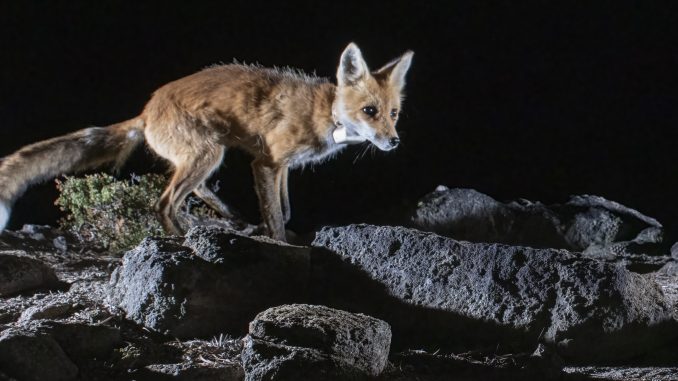
In the summer of 2024, when the roads opened again, and Robbins could get back to his equipment, he found exciting footage: He had caught a Sierra Nevada red fox on a camera trap, not just on a trail cam.
Carlson could identify the female fox by the collar, which had been placed in 2020. The batteries in the collars go dead in a couple of years. Once foxes are trapped and collared once, Carlson said, they get “trap shy,” and can rarely be collared again. She was excited to see this female still doing well.
“It gives us a good idea on survival,” she said. “Some of our other females that we’ve collared haven’t been as successful. We had one hit by a vehicle, and then we had one that we don’t know what happened to her, but she just up and died one day, and she was fairly young.”
Carlson estimates that the fox was 3 or 4 years old when she collared it and is now 8 or 9, very old for a wild red fox living in the mountains.
As a scientist, Carlson loved the camera-trap photo. As a photographer, Robbins was not so impressed. The fox was squatting and peeing on a bush, and wearing a GPS collar, which, to him, detracted from the shot.
“I mean, I finally got a fox on the camera trap! But it was just a weird picture, man,” he said with a laugh.
A feral fox in the mix
This June, when Robbins retrieved footage from his overwintered equipment, he found new fox video footage on the trail cam. There were three clips of what appears to be the same Sierra Nevada red fox as the one from the 2024 photo. She has a thick, full winter coat that is bright red, in dazzling contrast to the snowy surroundings. In broad daylight, she walks to a promontory, looks out over the ravine below, and looks around. Beyond her is a snowy mountain peak. In a second clip, she does a big stretch that will inspire anyone to do a little yoga. In a third, she settles onto the warm rock for a moment before moving on.
The footage has been shared by news sites worldwide. Several people have pointed out to Robbins that they have had red foxes in their yards. According to Ben Sacks, a mammal ecologist and geneticist at the University of California, Davis, the red foxes in yards are a non-native species descended from fur farms.
“There was kind of a craze back in the early 1900s,” said Sacks, who has been studying Sierra Nevada red foxes for about 30 years. “California’s a pretty ridiculous place to have a fur farm, but there were probably 50 or 60 of them throughout the state. By the mid-part of the century, it was pretty clear that it wasn’t economical. All of those fur farms went under—and presumably they just turned their foxes loose. Whether they escaped or were deliberately turned loose, nobody will ever know, but definitely that’s where they came from.”
Sacks said these non-native red foxes are found in the lowland of the Sacramento Valley. “We also have native Sacramento Valley red foxes also in the lowland, but north of Sacramento,” he said. “And then we have, of course, the Sierra Nevada red foxes. And yes, we have gray foxes throughout the state, although gray foxes and red foxes are as different as wolves and coyotes. They’re even more different.”
He said there are two populations of Sierra Nevada red foxes in California: one called the Sierra Nevada population that lives north of Yosemite National Park, and the Southern Cascades population in Lassen. Both populations were listed on the California Threatened and Endangered Species list in 1980. However, because there was so little data about the Southern Cascades population, it was not listed on the federal Endangered Species List when the Sierra Nevada population was added in 2021.
Sacks agrees with Perrine and Carlson that there aren’t many. He said there are “probably fewer than five breeding pairs, and it could be considerably fewer. It could be one or two breeding pairs.”
Puzzles in progress
Robbins has found himself explaining the differences between various species of foxes to numerous people on the internet. His video has captured a lot of attention, and the folks trying to save the Sierra Nevada red fox think that’s great.
Perrine, the CDFW wildlife supervisor, has a still of the video set as the desktop on his computer. “(Robbins’ footage) tells the public that these guys exist. It’s awfully hard to have a conservation program for a critter that people don’t even know exists. … Randy is this great ambassador for the mountain red fox, because he’s basically saying, ‘Look how cool this is!’”
Perrine also said that the photos provide data points for scientists. “If we know where a fox is, then we can maybe go find some poop from that fox,” he said. “From that poop, we can get DNA, and it’ll tell us exactly which fox that is, and it’ll tell us what he or she is eating, and things like that. That’s how we build our knowledge of the species, bit by bit.”
Robbins is still not satisfied. He’s been working for three years to get the right DSLR shot of a Sierra Nevada fox. His camera traps are still up, so the photo he envisions could be waiting for him now.
Once Robbins gets the proper high-resolution shot, what will he pursue next? Sacks, the UC Davis scientist, hopes it’s more Sierra Nevada red fox pictures, as there’s more to learn, especially about the fox’s three different coat patterns—various combinations of red, black and silver.
Robbins isn’t sure what he’ll pursue next. He loved photographing the Lassen pack of gray wolves and would like to get more photos of them. He hesitated, though, because the photo he got drew a lot of ire. (To conservationists, the return of wolves to California is a triumph; to cattle ranchers, it’s a threat to their livelihood. The disagreements can get contentious.) Then he reconsidered, recalling how many people reacted to “Lassen Pack Wolf,” saying they didn’t even know there were wolves in California.
“There are hundreds of people seeing (the Sierra Nevada red fox) for the first time, realizing that these animals exist, that we need to be doing something to protect them—and I think that happens with wolves, too,” Robbins said.
He has considered trying for a photo of a wolverine, but he said it’s not clear that any are established in Northern California; they are likely just passing through. Perrine also thinks a wolverine photo would be great, but pointed out, “The problem with that is you could spend years looking and not finding, and that gets hard on the soul, right?”
Whatever Robbins’ next subject is, it will be beautiful—and tell an engaging story about wildlife in the Sierra Nevada.
Capturing such a rare and elusive species like the Sierra Nevada red fox really highlights how much patience and technical understanding wildlife photography demands. Achieving accurate colors in snowy, high-altitude environments can be especially challenging, which is why learning about wb camera meaning can make a noticeable difference in getting those natural, true-to-life tones. Moments like these show how the right knowledge and persistence come together to document something truly special—looking forward to seeing what comes next in this ongoing search.