
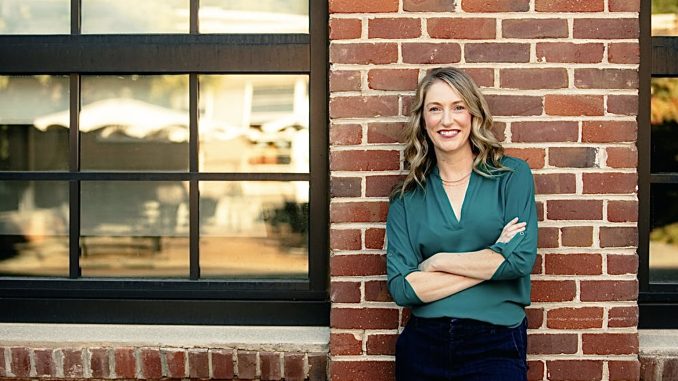
Candidate talks about affordability, farming, housing, LGBTQ+ rights and the passing of a district mainstay
By Ken Magri
This fall, North State voters will elect a congressional member to represent them in California’s recently re-drawn District 1, which includes new regions with differing political concerns.
After the passing of Proposition 50 last November, and the unexpected January 6 death of Representative Doug LaMalfa, a change in representation is guaranteed for 2027.
This year, CN&R asked each candidate in the District 1 race for an interview to discuss policies that affect the nation, in general, and local voters in particular. Our first interview is with Democrat Audrey Denney.
Denney grew up on a Paso Robles cattle ranch that also raised horses and grew grapes. As a kid, she was a member of 4-H and the Future Farmers of America. After moving to Chico in 2004, she earned a Bachelor of Science degree and a Master of Science with honors in Agricultural Education from Chico State University. Denney’s thesis on agricultural sustainability took first place throughout the CSU system for its research.
Denney is proud of her experience and knowledge of agricultural issues, telling News & Review, “In Congress, I want to sit on the Agriculture Committee. I want to sit on the Natural Resources Committee.”
Like many Chico State graduates, Denney followed her dreams by putting those degrees to good use. She worked in El Salvador with human rights groups on the problem of food insecurity, and now serves as a consultant for food banks across America. Denney also helped mobilize forces during the Oroville Dam crisis and the Camp and Carr fires.
She currently teaches in Chico State’s Communications Sciences and Honors Programs.
Because the following interview was conducted on morning of January 6, CN&R asked Denney for a statement on the passing, just hours earlier, of District 1 Representative Doug LaMalfa.
“My thoughts are Congressman LaMalfa’s wife, Jill, their children and entire family today,” Denney said. “I appreciated his willingness to serve the North State for decades.”
Likewise, we asked for a statement on the fifth anniversary of the January 6 attack on the U.S. Capitol. As the Democratic Party’s congressional candidate who lost in 2020, Denney said that she sat in her Chico apartment watching and wondering as Trump supporters violently fought with Capitol Police.
“It’s a somber day, a day that I’m reflecting on where President Trump has taken our country,” Denney recalled. “Since then, he has continued to attack our courts and elections, the press and civil servants…all the while he is concentrating power, rewarding loyalty over law and enriching himself and his family. What we’re seeing is what authoritarianism looks like in real time.”
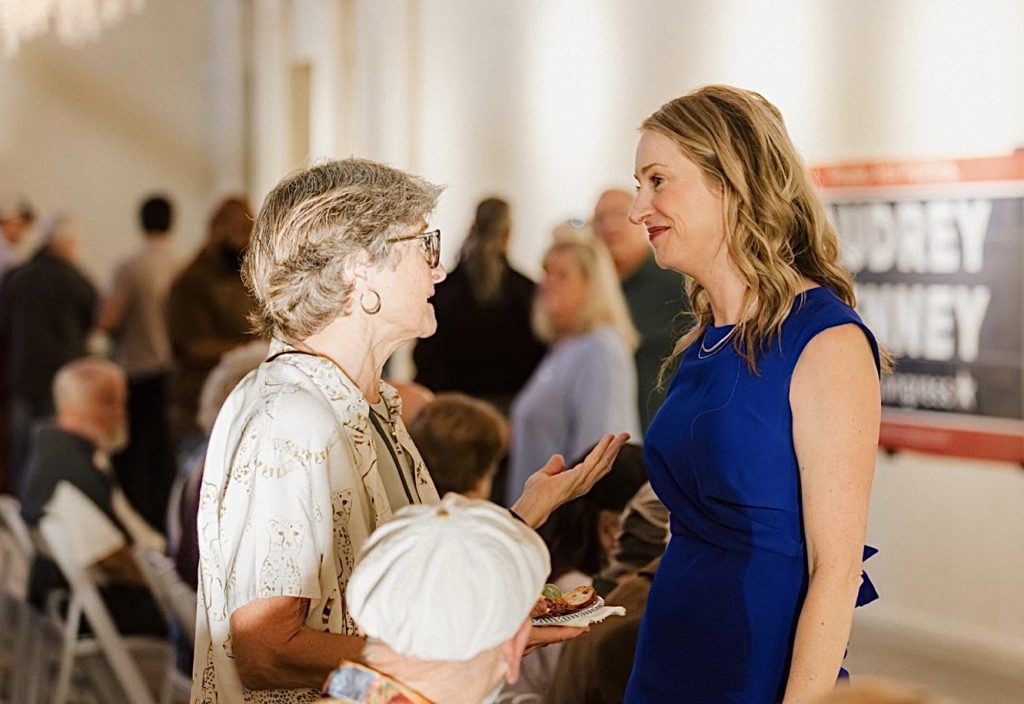
Chico News & Review’s Interview with Audrey Denney
CN&R: So much is happening in the news this week. What is your reaction to the US military extraction of Venezuela’s President Maduro?
Denney: I want to be clear about two things at once. The Maduro regime is authoritarian, illegitimate and responsible for more enormous human suffering and one of the largest refugee crises in the world. At the same time, kidnapping leaders or threatening regime-change in another country is not justice. It’s lawless, destabilizing and guaranteed to create more suffering.
I worked in Latin America alongside a human rights organization defending victims of state violence. So, I have seen firsthand how reckless foreign interventions always land on civilians. Trump’s “America first” policy is turning into “America alone.”
CN&R: A recent poll showed that Democrats in congress have a record low 18% approval rating, yet another poll showed that US voters want Democrats to regain the majority over Republicans in the House of Representatives by a 47%-42% margin. How do you square such different statistics?
Denney: I think that the Democratic Party too often has failed to live up to our values and that is why people are turned off. We keep electing Democrats who take corporate Political Action Committee (PAC) money and are beholding to the systems we’re trying to change.
We keep electing Democrats that think incrementalism leads to policy change. They confuse caution with leadership, instead of actually delivering on real change. What we need at this moment is a new generation of leaders who aren’t bought and paid for by corporations.
We need to completely reform and take profit out of our health system, so people can get care. We need to attack the housing crisis, so people aren’t spending 50-60% of their income on rent. We need a Democratic party that will deliver, and the only way we will get that is to elect Democrats who don’t take corporate money.
CN&R: Are you saying that you do not take corporate PAC money?
Denney: I have never taken a dime of corporate PAC money and I never will.
CN&R: Affordability will be a big issue in this election, and a huge part of that problem is affordable housing. The district and entire nation are in a housing crisis. Can anything be realistically done?
Denney: Nationwide, we are short of more than 7 million affordable homes. In Congress there are levers I can press, starting with fully funding and modernizing United States Department of Agriculture’s (USDA) rural development housing programs to make sure rural communities get the investment help they’ve been promised. I think we can expand the low-income housing tax credit and target those investments towards rural builders in underserved communities.
There needs to be system change around Wall Street investors trying to drive up prices, because it is locking working families, Millennials and Generation Z out of home ownership.
CN&R: Do you mean to say it’s time to reign in corporate home buying?
Denney: Absolutely. All this is happening at a time where Wall Street investors are buying up starter homes. I think that is one of the core parts of the problem because there is not enough housing left after they come in.
CN&R: One of the biggest issues for voters in District 1 is agriculture. Whether it is a grape farmer on the western side of the newly drawn district or a nut farmer in Butte County, why should farmers give you their support?
Denney: I grew up on a cattle ranch and vineyard, and both of my degrees are in agriculture. I worked with agriculture industry groups in food security and natural resource management for my entire career. I know firsthand the risks farmers and ranchers take in one of the most volatile eras that agriculture has faced.
When I talk to farmers and ranchers, the biggest thing they are worried about is losing markets because of the tariffs. Our California wine grape growers lost 25% of their market overnight, grapes that were sold to Canada. Those aren’t markets that can be automatically restored. They took decades to build up.
I want to help change from favoring large corporate farmers to putting family farmers in rural communities at the center of agricultural policies.
CN&R: Are there any policies that would cause tension between District 1 nut and rice farmers versus grape growers on the western side of the new boundary?
Denney: There aren’t, and let’s look at the whole district too, because we go up to Lassen, Plumas and Sierra Counties where there are a lot of cattle ranches. In the valley you get more nut farmers, but there is a lot of rice here too, then moving west over to the grape growers. Our grapes and tree crops all fall under the category of specialty crops. Those don’t have big conflicting policies.
CN&R: In policy statements you have connected the importance of wildfire mitigation to a healthy grape industry. Can you explain the connection?
Denney: Wildfires and smoke have disrupted multiple vintages when the fires come and the grapes are already on the vine. To get the California wine industry back in sync, more vines have to be pulled out…The vineyards that can sustain this downturn in the market are big corporate players, who are buying up small lands. The farmers we are losing are family farmers, the small farmers.
CN&R: The LGBTQ+ community feels abandoned by the Republican Party and the late congressman on health care, marriage and privacy issues. It is also tired of being used as political wedge issues that seek to divide otherwise agreeable Democrats. Why should the LGBTQ+ community support you?
Denney: I stand proudly and unapologetically with the LGBTQ+ community, including transgender and gender non-conforming people. Every single person is equal in worth and dignity, in rights and decisions about their bodies, health care and whom they marry.
Right now, especially trans youth are being targeted by a political campaign designed to manufacture outrage and divide us. Hundreds of these bills have been introduced to ban gender-affirming care, to censor classrooms, to push queer and trans people out of public life. None of it is about protecting children. It’s about using government power to control our bodies, our opinions and our identity.
CN&R: What is the last thought you would like voters to take away from this interview?
Denney: I am a person that will stand with working families and not corporate donors and fight for regular people. I believe that our democracy works better when regular people and not political insiders are in charge.

Such a great article, Ken! You really have an amazing talent for writing and reporting–keep up the good work! Amy B
Thank you for this article so people will understand Candidate Audrey Denney and the fact that she is transparent about where her campaign funds come from and I know she listens to her constituents. Her specific education and family background in agriculture also will serve the region so let’s put forward the qualified candidate.
Are there any events coming up for Audrey Denney? I’m in Redding but would drive to see her speak.
where can we get signs to put up in yards