
By Ken Magri
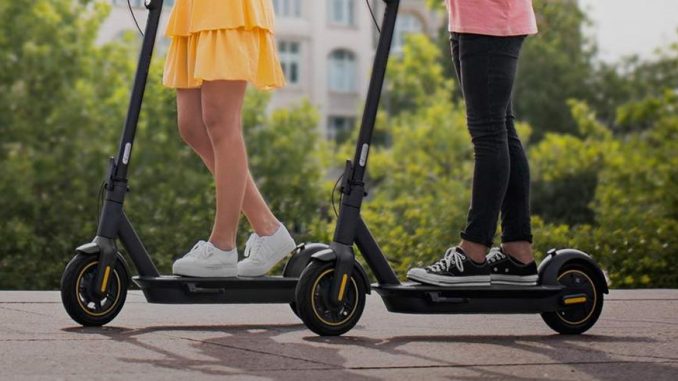
Electric scooter sales and usage are on the rise, including new “shared mobility” rental businesses that allow customers to rent a device in one location and leave it in another when they’re finished.
According to the New Urban Mobility Alliance, over 600 cities in 50 countries have taken over 300 million trips on e-scooters.
For Chico City Council member Addison Winslow, it’s time to consider a formal policy that regulates the usage of these vehicles inside the city limits.
A California state law passed in 2020 mandated that cities create regulations for electric scooter rentals, including parking allowances, safety concerns and possible infrastructure changes to allow for more environmentally friendly transportation options.
At Chico’s October 21 city council meeting, Winslow put forth a motion directing staff to bring back a report on how regulations of future electric bicycle and scooter rental businesses might play out. Winslow submitted a written set of “principals that we would approve such a program under” based on the regulations of Chula Vista, California, a city similar in size to Chico.
The principals include providing an affordable transportation service to the public, creating strict guidance for parking, that the scooters are maintained in good condition, the operation is as safe as possible and that the city of Chico is indemnified against liability lawsuits.
The city’s possible liabilities were a particular concern of Councilmember Tom van Overbeek, who said he has witnessed the scooters in other cities and “it can be a wonderful thing.”
“I watched the Action News segment on it and the thing that struck me was that all the people were riding these things on sidewalks and not wearing helmets,” said van Overbeek. “There also needs to be enforcement from PD…to make sure that we keep people off the sidewalks with those things.”
Mayor Kasey Reynolds added, “I just want to make sure that the information is brought back to us on liability … I think it’s fun, it’s great, it’s exciting. But I just want to look out for our liability.”
Councilmember Bryce Golsstein likes the opportunity for the council to learn more about shared mobility. But as an avid bicyclist, she was concerned about scooter interactions with bicycle riders.
“I have been seeing an increase in something specific which is people going the wrong way in bike lanes,” Goldstein noted, “and it’s especially scary if they are on an electric device.”
Goldstein wants to make sure scooter riders are educated on scooter safety through in-app tutorials. “I’m glad that this is coming back, even though I’m a little skeptical,” she said.
Councilmember Michael O’Brien likes the idea but not one of the company names.
“I’ve got to be honest, I do not like the name ‘Joyride.,'” O’Brien pointed out. “It makes me envision Grand Theft Auto or something.”
Nevertheless, O’Brien supported the motion. “Let’s give this a shot, but let’s make sure we do it right,” he concluded.
Joyride is the name of the Canadian company providing the operating software, including the rider app, GPS tracking, fleet management system, and payments. Roam is an independent business in Chico that will be renting out the scooters.
Chico businessman Raymond Swope, owner of Roam, spoke to the council about his pilot program.
“At its heart, Roam is about local mobility with local values,” said Swope. “We want to provide a reliable, eco-friendly and affordable transportation option for students, residents and visitors.”
Swope also addressed concerns raised by other cities where the rental programs caused clutter from dropped-off scooters and safety issues from inexperienced riders. He explained the smart-technology of “geo-fencing,” to control places where scooters can be ridden and parked.
For low-income university students, more zero-emission shared-mobility vehicles remains an important goal, according to Jesse Horgan, chairman of the Alternative Transportation Committee at Chico State who also spoke to the city council.
“The technology has come a long way in the last ten years,” said Hogan.
“Limiting speeds, locking the wheels and stopping mobility in certain areas and having GPS so the scooters can be located and moved” are three features Horgan cited as examples.
After a short and amicable discussion, Councilmember Van Overbeek formalized Winslow’s motion to instruct staff to move forward with passed unanimously.
How scooter rentals work, the pros and cons
Swope explained to News & Review that 100 scooters will be launched under a pilot plan, if approved.
“This size allows us to cover key areas like downtown and the university corridor while also giving us room to monitor usage, gather feedback and scale responsibility,” he said.
After evaluating several international scooter brands, Swope decided to use Segway shared-fleet electric scooters.
“They have a proven safety record, strong reliability in the shared-mobility industry, and features like swappable batteries and advanced braking that support daily public use,” Swope mentioned.
For the users of these shared-mobility e-scooters, they are an easy and flexible option for short trips. By helping to reduce vehicle emissions, e-scooters help the environment while easing traffic congestion. Not only are renting e-scooters less expensive due to their pay-per-use feature, they also eliminate a renter’s need to pay for insurance and future maintenance.
But when wrongly regulated, shared-mobility scooters can be a nightmare. In other cities, customers have simply dropped them on the sidewalk whenever they are finished. Parking and clutter can be a problem. Newly designated parking areas might need to be designated within the city limits.
Safety is also a legitimate concern. Even at 15 mph, e-scooters can injure pedestrians and other bicycle riders. E-scooters are generally not recommended for people who have balance issues.
New customers would need to also rent helmets and learn basic operational skills by installing a tutorial app on their phone. Without that app, there are no instructions on how to operate the vehicles safely and legally.
“Those things would need to be discussed. Collaboration with the police department is going to be essential,” said David Chiongco, Deputy Director of Planning and Engineering for the City of Chico. “Enforcement is probably the biggest [issue].”
I really hope there are some REGULAR (non-electric) bicycles included in this proposal.
This is what we’re worrying about in our downtown Chico. Riding scooters on sidewalks and helmets when we have people camping on the sidewalks, defecating, urinating, assaulting, drug use and more… Our police have plenty to worry about. We need to clean up our downtown before we do any of this.
E-bikes and E-scooters speeding on bike paths present another challenge I hope these folks will deal with. The speed limit on a bike path should match a reasonable safe high speed on a non-electric bike. Thanks!