
Silent era films shows the power of music in creating the atmosphere
By Ken Magri
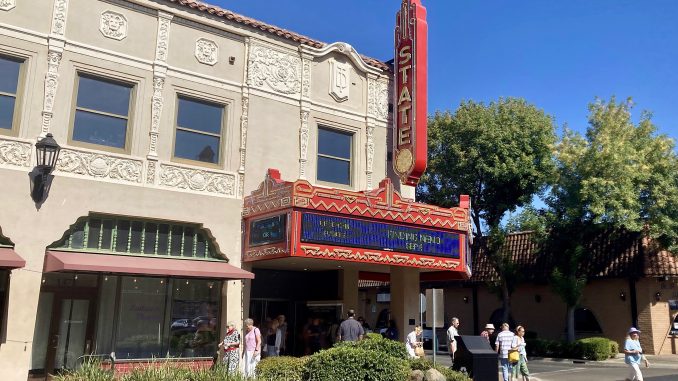
The historic Oroville State Theater was filled last Sunday for a special showing of old silent movies accompanied by live music on what’s called the “mighty Wurlitzer organ.”
Six short films from the 1910s and 1920s kept both grandparents and kids entertained with heroes, villains, pratfalls and chase scenes. Early stars like Mabel Norman tied to a traintrack, the Keystone Cops, Charlie Chaplin and Buster Keaton filled the big screen again.
For two hours it felt like being transported back a century ago, watching movies that one’s great, great grandparents might have seen.
The Master of Ceremonies was Jim Moll, a financial advisor who locals refer to as “the voice of Oroville.” With his involvement in so many community projects, Moll is perhaps the greatest advocate for Oroville itself.
Moll is also part of State Theater Arts Guild, or STAGE, which is a non-profit that operates the theater for the city. He dutifully encouraged attendees to support the building by becoming annual STAGE members.
Moll introduced each short film, explaining a bit of background on the stars, the storyline and how silent films were produced in Hollywood’s early era. The movies were made on 16 mm film reels lasting around 12 minutes each. These reels gave birth to the terms “one-reeler” and “two-reeler” to indicate a silent film’s length.
Because the first movies were made without sound, musical accompaniment helped to guide the plot developments. Romantic music was needed for a love scene and frenzied music for a chase scene.
These audio references helped narrate what was happening, moment by moment, up on the screen. In a small town, one might see a lone piano player off to the side of a movie screen, looking over at each scene and playing the appropriate music.
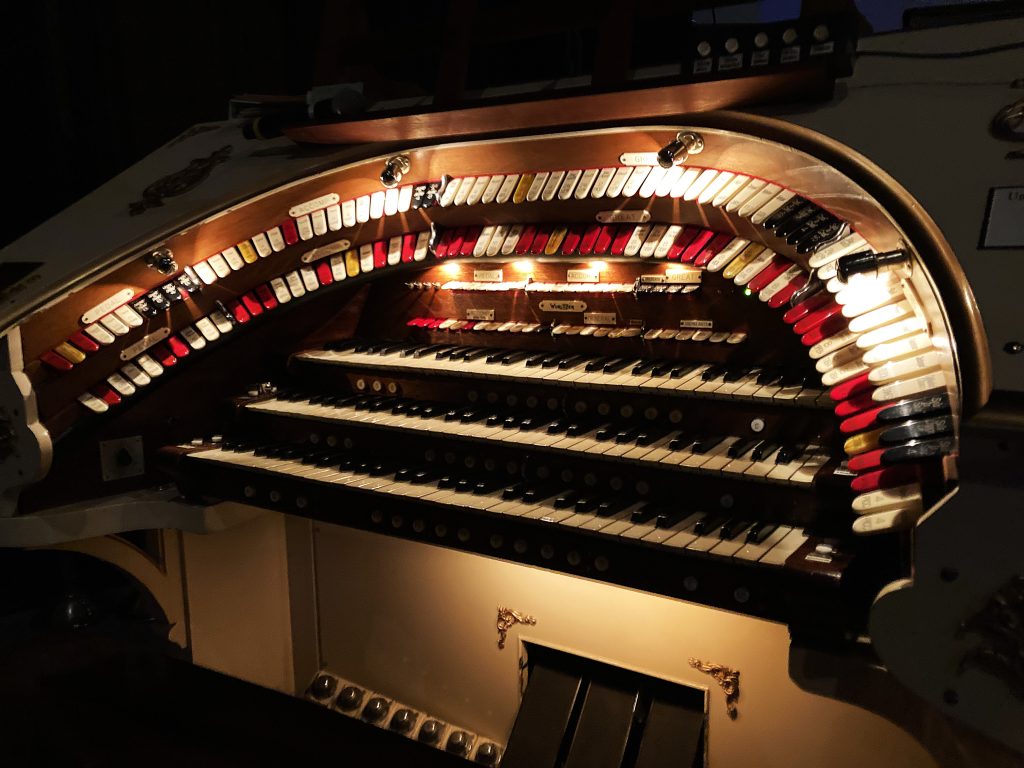
The Wurlitzer organ inside the State Theater
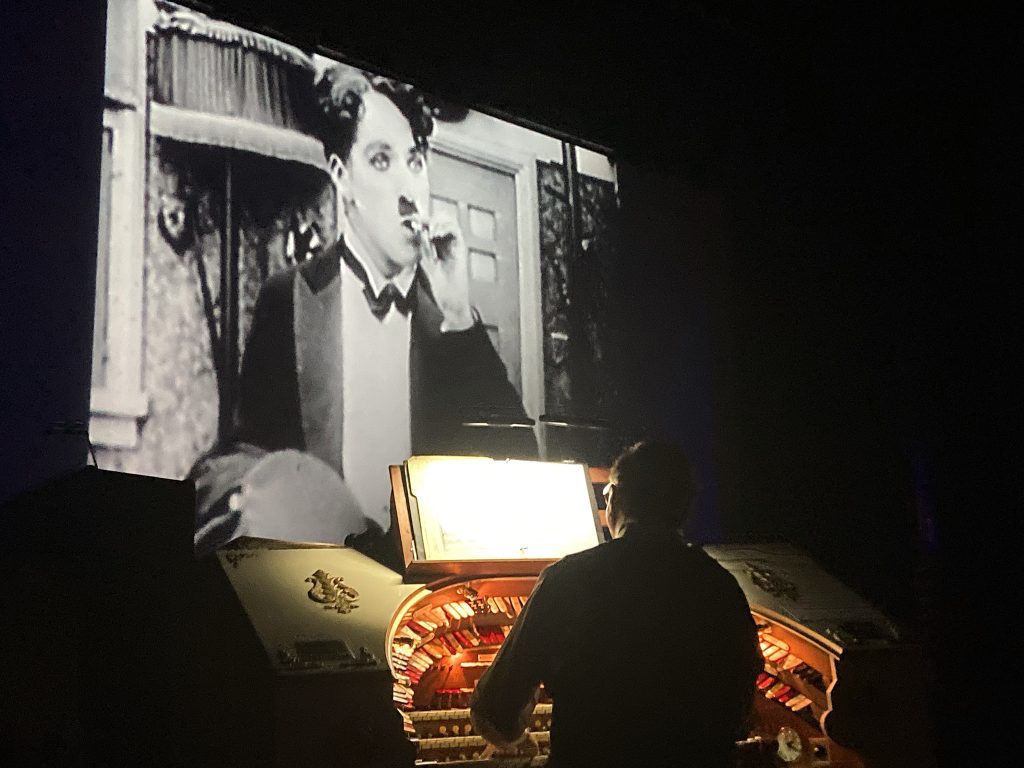
For larger theaters, Wurlitzer pipe organs were created to mimic an entire orchestra. Yet they could still be played by a single person.
The State Theater was built in 1928 by Bay Area architect Timothy Pflueger in a mildly Spanish version of Art Deco. Originally conceived with a chamber of pipes for an organ, a sudden transition to the sound-era of films ended the need for one.
By the mid-1930s, the heyday of pipe organs was in decline as theaters installed speaker sound systems. Wurlitzer stopped manufacturing theater organs in 1942.
In 2017, the Oroville State Theatre launched a restoration project to install this current Wurlitzer organ which was donated by the Mount Shasta Chapter of the American Theatre Organ Society. More pipes were added and the entire apparatus was restored by organist Dave Moreno with the assistance of local volunteers.
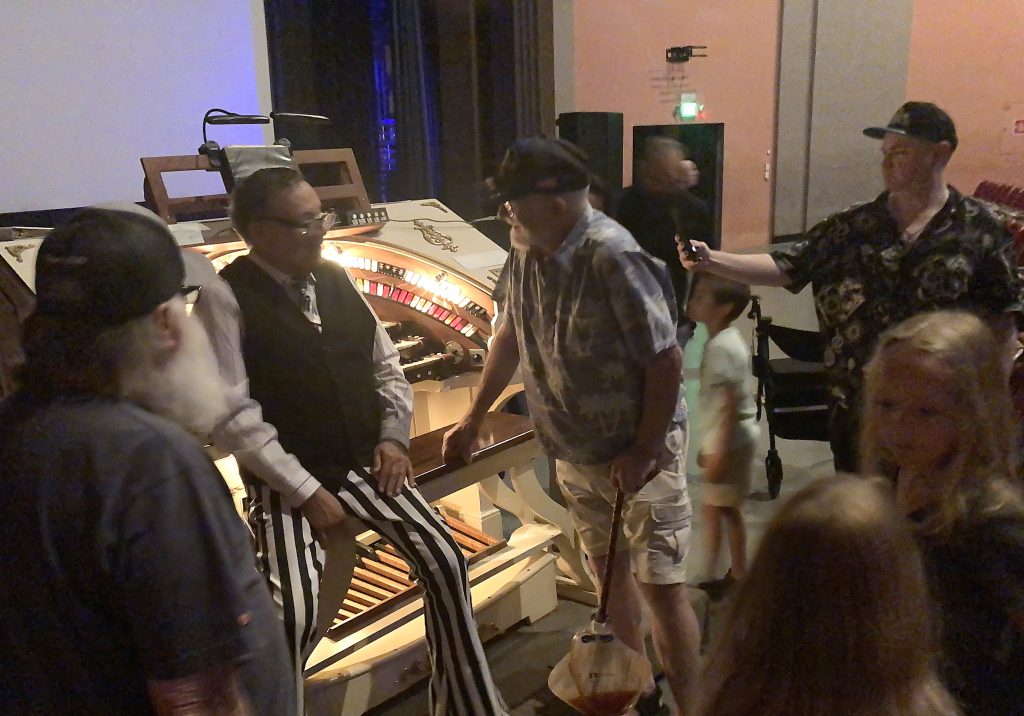
Between films, Moreno gave the audience a personal tour, as well as a demonstration of every sound the Wurlitzer could make, from strings and woodwinds to brass and percussion. He also showcased the instrument’s array of sound effects.
“We have grandma’s car over on this side, ‘Ahh-Oooh-Gaah,’ and if she goes too fast she gets this behind her, ‘Eeeeerrrrrraaaaaah!’” he explained. Moreno and the Wurlitzer then mimicked bird chirps, door knocks, horn honks, chattering teeth and a typewriter, “chicka-chicka-chicka, ting,” that he came up with himself.
But the real treat was hearing this organ in action while its sound is matched with the films, or as Moreno likes to express it, “Something you listen to with your eyes.”
The films: ‘One AM, starring Charlie Chaplin, 1916
By 1916, Charlie Chaplin’s little tramp character was world famous. After honing his film making skills under Mack Sennett at Keystone Studios, Chaplin signed with Mutual Films to produce a pair two-reel short films (around 24 minutes in length) each month for $10,000 a week.
Mutual built a small movie studio for Chaplin that featured fake residential housing on the outside to blend in with the neighborhood and provide him needed privacy. Now in control of his own product, Chapman considered his Mutual years his happiest.
The film “One A.M.” features Chaplin, dressed in top hat and tails, as a wealthy man coming home drunk. Filled with his brilliant physical timing, it uses many of the drunken-man routines he performed in Vaudeville before coming to Hollywood.
Moreno continuously looked up at the screen and timed his notes to match the film’s action. While playing through a range of percussive instruments, he was in full command, adding to each of Chaplin’s staircase falls with a marimba arpeggio and a boom on the base drum.
‘One Week’ starring Buster Keaton, 1920
In an era of exaggerated acting, Buster Keaton was nicknamed “the great stone face” for his ability to convey everything with his eyes and movements. Yet he may have been the best physical comedy actor in the history of Hollywood.
In “One Week,” a newlywed couple tries to build their own little castle from a mislabeled house-building kit. The film showcases Keaton’s ability to perform stunts no other actor would try, like sawing himself off a dangling piece of lumber. With the talent of a stuntman, Keaton displays his ability to dodge falling walls, balance on a two-legged ladder and stay upright in a free-spinning interior.
In the end, the couple’s crazy house gets stuck on a train track, narrowly avoiding one train while falling victim to a second one. The chugging, whistling and crashing sounds of each passing train were beautifully showcased by the Wurlitzer.
‘Two Tars’ starring Laurel and Hardy, 1928
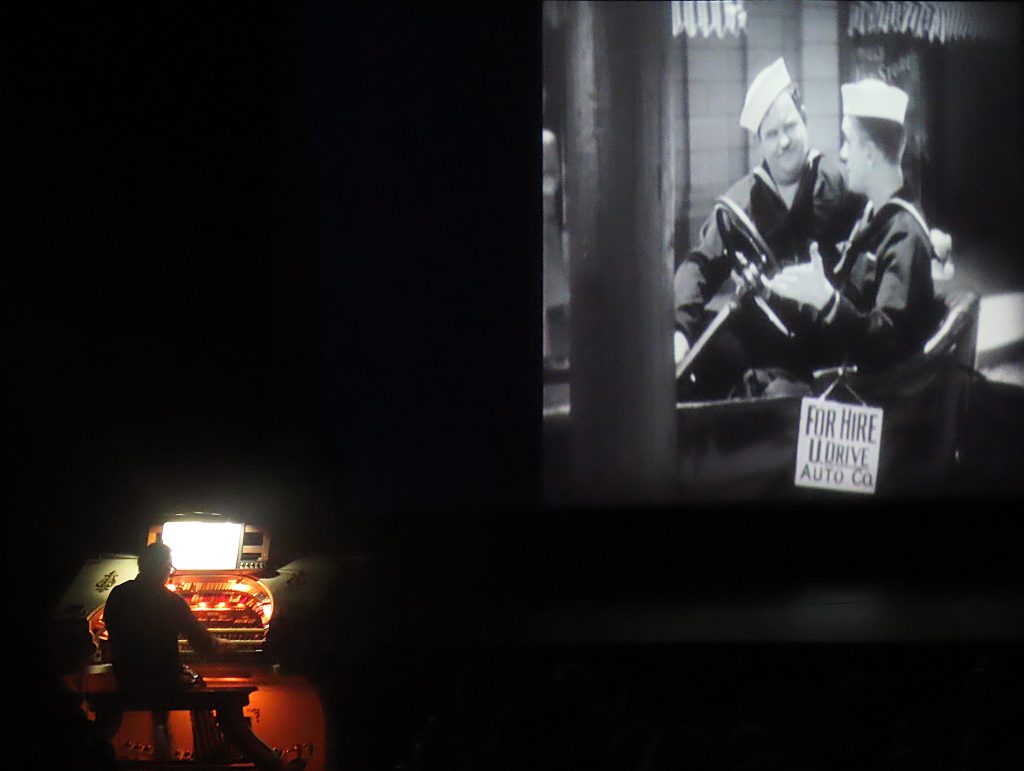
This was an early pairing for the famous comedy duo Stan Laurel and Oliver Hardy, filmed a year after the invention of talking films when the State Theater had just opened and studios still produced silent films for small-towns. It was interesting to see the vacant fields in Santa Monica where these scenes were filmed 97 years ago.
A very young-looking Laurel and Hardy play a pair of sailors on shore leave who meet two nice girls. Moreno begins with romantic music until things take a turn.
After driving into a pole and destroying a storefront gumball machine, the foursome gets caught up in a long traffic jam/fight/car chase sequence that had Moreno rapidly working all of the sound effects on the Wurlitzer.
Some of these silent films can now be viewed on YouTube, scored by a simple organ. But to be surrounded by the State Theater’s acoustics, and hear the tall pipes come alive, was a richer, more authentic experience.
One could almost draw an arc back from the origins of California’s film culture to the effect it still has upon all or our lives.
This is awesome. I love to attend the next one.