
By Samin Vafaee
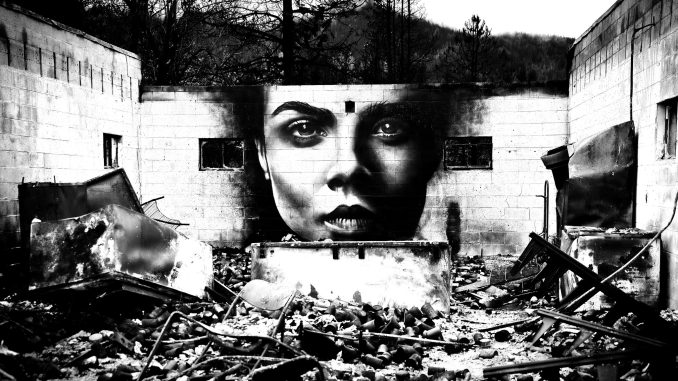
Although you may have seen Shane Grammer’s pieces at Disneyland, Legoland or Epcot, some of his most meaningful work has been done right in his own home town. Grammar, a street muralist and scenic design fabricator, is originally from Chico. He’s also spent his share of time in Paradise. So, when the Camp Fire took 86 lives and 19,000 buildings from that community in November of 2018, Grammer felt a responsibility to contribute through his art.
Following the catastrophe, Grammer reached out to his friends Shane and Jennifer Edwards, whose home was destroyed in the inferno. That structure, near the entrance to Paradise, only had a single chimney left in its place.
“When I saw that chimney, I thought, ‘Man, I’ve got to paint that,’” said Grammer.
Grammar soon transformed the charred chimney into the portrait of a woman in black and white.
“I honestly didn’t think anyone would care other than my friend,” the artist recalled.
But after a picture of Grammer’s portrait was posted on the “Paradise Camp Fires Survivors” Meta page, the image went viral.
“If you’ve ever met anybody that’s a Camp fire survivor, the first thing you’re going do is listen to their survivor story for about an hour,” Grammer reflected. “For any artist, I think your soul purpose and desire is that you want to create artwork that connects with people.”
After Grammer realized the impact that his art brought to a recovering Butte County, he painted about 24 more murals and held an exhibition in Chico that raised $60,000, with the funds going to both the Paradise Art Center and trauma relief for survivors.
The first chimney mural of the woman was famously named “Beauty in the Ashes” by the Paradise community.
“People were like, ‘I don’t care what you paint, just paint something beautiful,” Grammer noted. “Those murals became a beacon of hope when they lost everything.”
Grammar also recalls how the murals organically morphed into a part of the community. After about 10 murals were painted around the town, survivors, photographers, and volunteers would come together in front of them and share conversations and experiences. Most of the murals painted in Paradise are portraits of women or children, including some being inspired by the survivors themselves.
One mural that stands on a single brick wall among the wreckage is of Grammer’s friend’s three-year-old daughter looking up to the sky with hope.
Although much of Grammer’s work on canvas follows the same theme, he attributes his portraits of women to his faith.
“When I paint a woman’s portrait on a burnt down car or building, it’s my sneaky way of saying Jesus loves you, and Jesus cares about your community.” Grammer acknowledged.
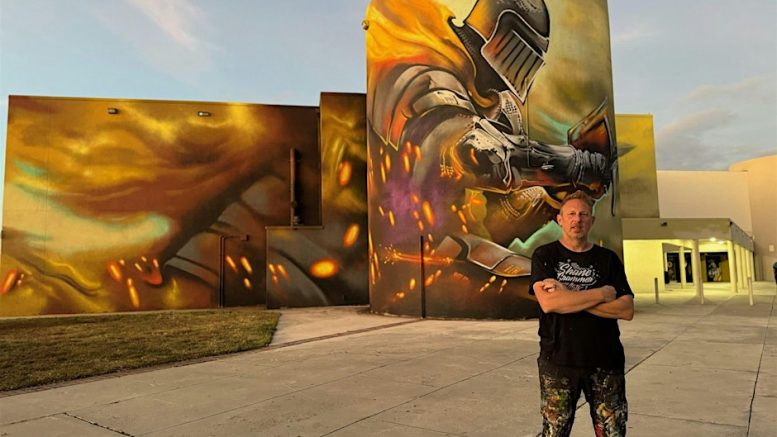
One person who’s been struck by Grammer’s artistic mindset and achievements is Vanessa Richardson of California Groundbreakers. After being inspired by cultural events held in pubs around London, Richardson started bringing similar salon-style events to her hometown of Sacramento. Grammer was the special guest for one of her recent gatherings.
“I was thinking about talks on art, and I just thought, ‘I want talk to this guy Shane Grammer,” Richardson told the crowd.
Richardson went on to highlight Grammer’s foundation, Hope Through Art. Grammar explained this initiative was actually born from what happened in Paradise and it has since worked with a variety of organizations on storytelling and creating awareness through art.
The foundation’s first project was entitled “Can You See Me?” It was a transparent piece of glass in the woods with a woman’s portrait on it to spotlight child trafficking. Grammer also finished another project working with Native Hope’s Missing and Murdered Indigenous Women initiative. He says that caused a chain reaction of creativity for him. Grammar has now completed 20 mural projects all over California with MMIW.
Richardson rounded-out the event by opening up the conversation to attendees: Grammar was asked about his work with Disney, art installations around California’s capital, as well as his most recent work displayed at Art Basel in Miami.
One attendee wanted to know how growing up in Chico had influenced the art that’s defined Grammer’s life and career.
“I think it’s the close-knit sense of community: Everybody knowing everybody,” the artist responded, “people willing to be there for each other.”
Be the first to comment